Interview profile radar
The Interview profile card on a Risenoow candidate record draws the voice interview as a five sided shape: one point for each dimension the AI read from the conversation. A dashed line shows the average of everyone else interviewed for the same role, so you can see at a glance where this person stands out and where they sit with the field.
Where: Candidate record, Overview tab, first card on the left
Who can use it: Admins, and recruiters for the roles they created
Time needed: Under a minute
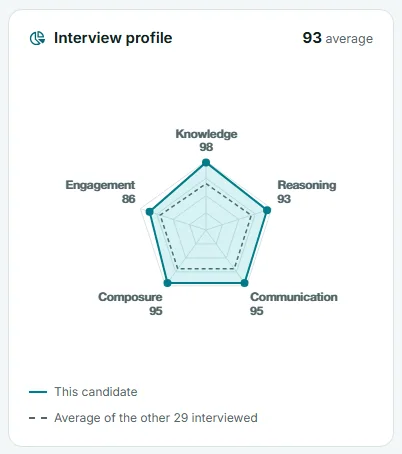
What the five points measure
Each point is a score from 0 to 100. The chart uses short labels; the full names appear on the Dimension by dimension card.
| Chart label | Full name | What it asks |
|---|---|---|
| Knowledge | Role knowledge | Do they know the work? Depth on this role's actual domain, shown through specifics rather than familiarity with the words. |
| Reasoning | Reasoning | How they work through a problem: is the answer structured, does it hold up when followed, do they separate what they know from what they are guessing? |
| Communication | Communication | Was the answer clear, organised and specific? Never accent, grammar, vocabulary range or filler words. |
| Composure | Composure when pushed | When the interviewer asked for specifics or followed up on something unprepared, did the answer hold, change or fall away? |
| Engagement | Engagement | Interest in this role in particular: what they asked, what they knew about it, how constructively they described past difficulty. |
A score of 50 means an ordinary answer for the role. It is not a pass mark and not a failure.
How to read the two lines
- The solid line with a filled shape is this candidate.
- The dashed line is the average of the other candidates interviewed for this role. The legend says how many, for example "Average of the other 29 interviewed".
The average leaves this candidate out, so their own scores do not pull the line towards them. A dimension another candidate's interview never evidenced is also left out of that average.
Where the solid shape sits outside the dashed one, this candidate did better than the field on that dimension. Where it sits inside, the field did better.
Hover over a point to see the full dimension name and the exact score, for this candidate or for the field.
Good to know
A large shape is not automatically a good hire. Look at which dimensions matter most for this role. A support role may lean on communication and composure; a specialist role on role knowledge and reasoning.
Hollow points mean thin evidence
A filled dot means the score rests on solid evidence. A hollow dot means the interview gave little to go on for that dimension: the reading marked it low confidence, which always happens when no exact quote from the candidate supports it. Read hollow points lightly. When you hover over one, the tooltip adds "little evidence".
When the dashed line is missing
The field line is drawn only when every one of the five dimensions has at least one other interviewed candidate behind it. A shape with three points measured and two guessed would mislead, so the chart shows this candidate alone until there is enough.
When the chart is empty
The empty five sided frame still shows when there is no reading, with one of these lines underneath:
- "No voice interview yet, so there are no scores to plot."
- "The interview has not been read yet, so there are no scores to plot."
- "The interview was too short to score: under 60 words came from the candidate."
The figure at the top right then reads "No reading yet" instead of the average.
The average in the corner
The number at the top right, for example 93 average, is the plain average of the five scores. It is the same figure as the Interview average tile above. See Score tiles.
Frequently asked questions
Does the radar judge how the candidate sounds?
No. The reading uses the transcript only: what the candidate said. Accent, grammar, filler words, hesitation and tone are never scored, and the AI interviewer's own questions are not counted as evidence.
Why is my strong candidate below the dashed line on one point?
The field may be strong on that dimension, or this candidate's interview touched it lightly. Open Dimension by dimension, pick that dimension and read the evidence and the suggested question.
Who counts as "the other interviewed"?
Other applicants for the same role who have a match score and a voice interview reading. Applicants for other roles are never mixed in.
Is the technical interview shown on this radar?
No. The technical interview has its own Technical profile radar on the Technical interview tab, with the first interview drawn beside it.