Scores explained
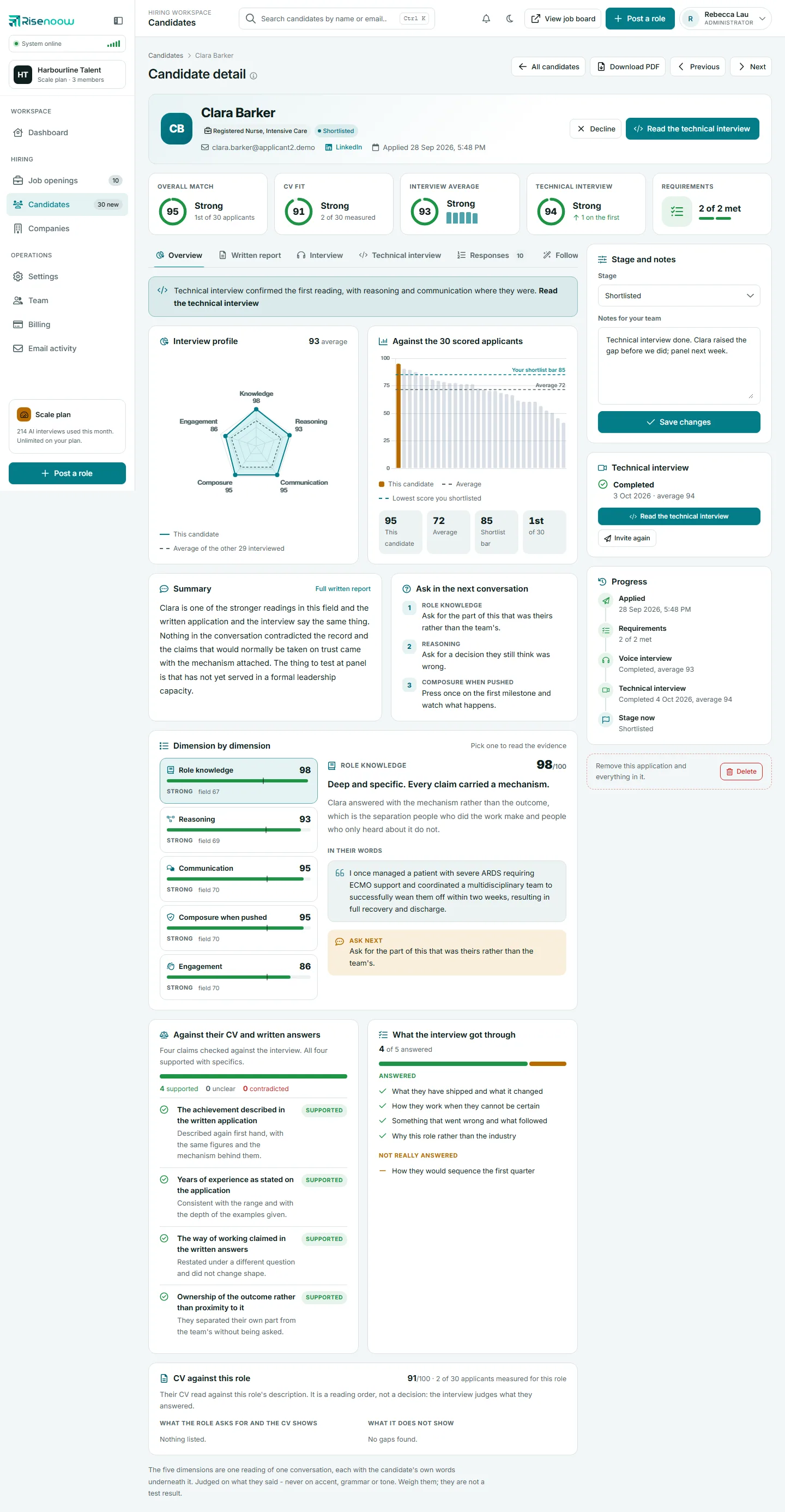
Risenoow shows several numbers about a candidate, and each one answers a different question. This page lists every score in the product, what it is read from, what the words beside it mean and, just as important, what it does not tell you.
Where: Candidate record, Candidates page, dashboard, candidate portal
Who sees it: Your hiring team; candidates see their own scores in the portal
Time needed: Five minutes to read
Every score is a reading, not a verdict
The AI screens and organises. A person decides. Every interview score carries the candidate's own words underneath it, so you can check it in seconds.
Overall match (Match score)
The main score, out of 100. It appears as Overall match on the candidate record and as Match score on the Candidates page and the dashboard. It is the same number.
- Read from: the written report, which weighs the written answers, the voice interview transcript, the follow up answers and the CV together.
- Words beside it: Strong (80 or more), Solid (65 to 79), Mixed (50 to 64), Limited (30 to 49), Little evidence (under 30).
- Rank: "1st of 30 applicants" places the candidate among the scored applicants for the same role.
- Shown as Scoring: the report is still being written.
- No overall score stated: the report was written but gives no number. Read the report itself.
The written report also gives category scores from 1 to 10, or "No evidence" where there is none, and a recommendation: Proceed, Proceed with caution, Do not proceed or Insufficient evidence. A candidate who supplied little is scored low because it is unevidenced, not padded.
It does not mean: a test result, or a ranking against people who applied for other roles.
CV fit
How well the CV matches this role's job description, out of 100.
- Read from: the CV alone, measured against the role's description.
- Words beside it: Strong (70 or more), Fair (50 to 69), Weak (under 50).
- Rank: "2 of 30 measured" counts only applicants whose CV could be read.
- No CV to read: the candidate gave no CV, or it could not be read.
It does not mean: how good the candidate is. It is a reading order, a way to decide whom to open first. The interview judges what they can actually do.
Interview average and the five dimensions
The voice interview is read on five dimensions, each scored from 0 to 100. On this scale, 50 means an ordinary answer for the role, not a failure. Interview average is the average of the five, with the same words as the overall match.
| Dimension | What it asks |
|---|---|
| Role knowledge | Do they know the work, shown through specifics? |
| Reasoning | Are answers structured, and do they hold up when followed? |
| Communication | Was the answer clear, organised and specific? |
| Composure when pushed | What happened when the interviewer asked for specifics? |
| Engagement | Interest in this role in particular. |
Each dimension shows a confidence of high, medium or low. A dimension with no quote behind it is always marked low confidence.
It does not mean: a judgement of accent, grammar, vocabulary, filler words, tone, emotion or personality. The reading uses the transcript only, never the sound of the voice. A very short interview, with fewer than two answers or only a few dozen words from the candidate, gets no reading at all rather than five guessed numbers.
Technical interview
For candidates who sit the second stage interview, the Technical interview tile shows the average of the same five dimensions from that conversation. Beside it you see how far it moved from the first interview, for example "1 on the first" with an arrow, or "Level with the first". The first reading is never rewritten.
Requirements
Not a score but a count: 2 of 2 met. It shows how many requirement questions the candidate met. The tile turns amber when one is missed and red when the application was declined automatically.
Scores on the dashboard
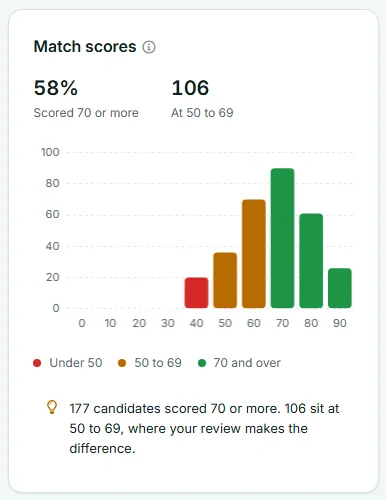
- Match scores chart: every scored candidate in 10 point bands, coloured Under 50, 50 to 69 and 70 and over.
- Avg candidate score card: the average match score across the roles you can see.
- Top candidates to decide on: the highest match scores not yet shortlisted or declined.
Scores a candidate sees
- Score on each application: in Applied jobs, candidates see the match score for each application once it is ready.
- Avg screening score: the average of those scores. Next to each role, the typical applicant score appears once at least three other people have been scored for it.
- Resume review score: the candidate's own check of their CV against a job they choose, labelled Strong match (70 or more), Partial match (50 to 69) or Weak match (under 50). It scores the CV alone. It is not the score an employer sees, which also counts the interview and the answers.
Frequently asked questions
What is a good match score in Risenoow?
80 or more reads as Strong and 65 to 79 as Solid. Compare within one role: the chart on the record shows the average and the lowest score you have already shortlisted.
Why are CV fit and overall match so different?
CV fit reads the CV alone. Overall match also reads what the candidate said and wrote. A thin CV with a strong interview is common, and that is the person the interview exists to find.
Does the AI score a candidate's accent or nerves?
No. The interview reading is taken from the transcript, and the instructions forbid judging accent, grammar, filler words, tone or emotion.
Can a candidate see their match score?
Yes. Candidates with a portal account see the score for each application under Applied jobs. They never see your notes.
Is the candidate's own CV score the same as CV fit?
They use the same kind of measurement, but they are separate. The candidate chooses the job for their own check, and it stays private to them.